
“You must dedicate yourself to continuous personal improvement – you are your most precious resource.”
Brian Tracy
According to the Berkley Wellbeing Institute, personal growth is a process of developing new skills, attitudes, actions, or reactions that can have a positive impact on your life.
When it comes to personal growth in leadership, it’s more specifically about developing and refining skills, qualities, and behaviours which enable us to effectively lead and inspire others.
In this article, we explore why personal growth is important when it comes to leadership progression and how as coaches, we help our clients to first identify, then bridge skill gaps which may be holding them back.
Executive Coaching and Personal Growth
There’s no such thing as a fully developed person; with so much out there to learn, working on ‘self’ is a limitless process. In highly competitive environments such as corporate leadership, this need for continual development is heightened.
When it comes to climbing the corporate ladder, newly promoted leaders will often hold onto the styles and methods of working which served them well in their previous level of leadership. Great leaders understand, however, the skills which made them successful at one level of leadership are not necessarily going to make them successful in the next.
Executive coaching is all about client growth. Whether the client is transitioning to a new role and/or organisation, aiming for the boardroom or hoping to become a non-executive director, coaching it’s about supporting, encouraging, and guiding clients on that journey.
“Change is inevitable, growth is optional.”
John C. Maxwell
As coaches, we utilise a range of highly effective development tools and our lived experiences to help executives and c-suite leaders to gain clarity around their ambitions, achieve self-awareness and design a plan to reach their goals.
One such development tool, is The GROW Model:
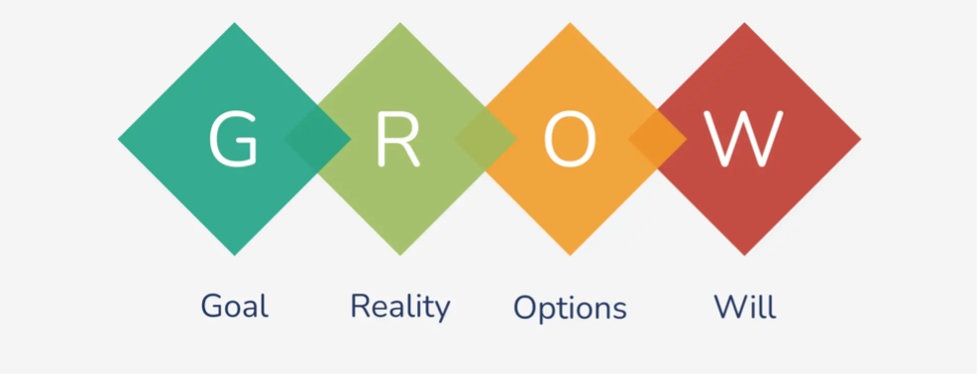
Developed by a pioneer of executive coaching, Sir John Whitmore, GROW is a highly effective goal setting and performance enhancing framework, inspired by development strategies used in sports coaching.
Coaches readily use the GROW acronym, which stands for Goal, Reality, Options and Will, to help their clients understand where they are, where they want to be and how to get there.
Goal: What is it you wish to achieve? How will you know you have achieved it? What do you stand to gain from reaching this goal?
Reality: Where are you know? What have you achieved so far which is relevant to your goal? What skills/experience/resources do you have at your disposal to help you to achieve this goal? What skills/experience/resources do you need to get you there (skill gaps)?
Options: In a perfect world, how would you achieve your goal? What are the obstacles to your goal? How could you overcome those obstacles? What tools will you need? What are the possible outcomes?
Will: What actions are you going to commit to? When will you have undertaken these actions? How do you think you will feel once you have achieved these actions?
When it comes to coaching, GROW is a simple and effective model which encourages client self-awareness and promotes clarity around both goal setting and action planning – making it an excellent tool for personal development.
The Comfort Zone
“Growth is often uncomfortable, messy and full of feelings you weren’t expecting – but it is absolutely necessary.”
Unknown
Self-development with a coach can be extremely rewarding, but requires the client’s commitment, self-reflection, and a willingness to step outside of their comfort zone.
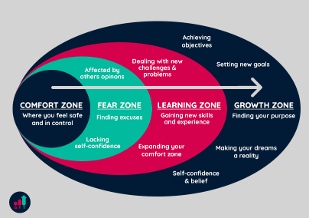
The above ‘Comfort Zone Model’ is derived from the ‘Learning Zone Model’, originally designed by psychologist Lev Vygotsky. It details 4 ‘zones’ which our clients (supported by their coach) are required to pass through if they are to achieve their goals.
Comfort Zone
Your comfort zone is a place or situation where you feel at ease, confident and safe. Here there are no risks to take and no challenges to overcome – making it an attractive space stay. The problem is, however, the longer someone stays in their comfort zone, the less they’ll want to leave – and in it, there is no space to achieve personal growth.
“If it doesn’t challenge you, it won’t change you.”
Fred DeVito
Fear Zone
When a client makes the decision to step out of their comfort zone, they enter unfamiliar territory, causing new anxieties to surface and their confidence to decline.
This is a perfectly normal response.
As uncomfortable as this zone is to pass through, doing so is crucial. It’s at this stage that most people give up, giving into their fears and finding excuses not to carry on. It’s our role as coaches to support our clients as they transition though the fear zone and overcome their anxieties to keep them on track to achieving their goals.
Learning Zone
Every time a client overcomes their fears and acts, they learn something new. The learning zone brings with it new experiences and the opportunity to hone skills; it’s where a client really starts to get some traction in their personal development plan.
Growth Zone
This zone is where everything which has been learned and experienced by the client in their journey, really comes together. Having reached their desired goal, they’ll have gained confidence in their new space.
This zone is called ‘growth’, as self-development doesn’t stop here. By continually developing leadership skills and qualities, our clients become more effective leaders who inspire and empower those around them.
“When you cross your comfort zone, fear zone, learning zone and growth zone, you will enter into the zone of leadership.”
Amit Ray
Once our clients have reached the Growth Zone, they are then in the position to start setting and working towards ‘self-actualisation goals’.
Self-Actualisation Goals
“Self-actualisation is to become everything one is capable of becoming.”
Abraham Maslow
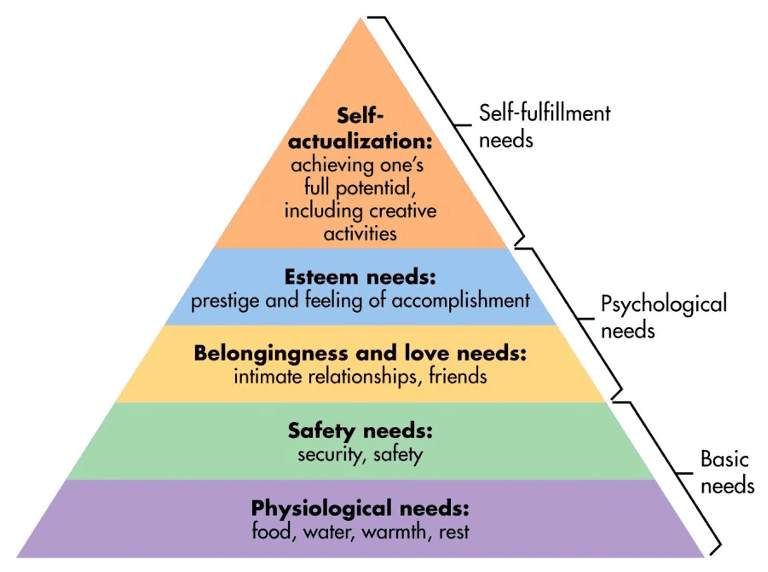
The brainchild of American Psychologist Abraham Maslow, the Hierarchy of Needs describes the 5 tiers of human motivation. He theorised that in order for the higher needs in the model to be realised, the lower, more essential tiers must first be met.
For example, the basic ‘physiological needs’ are all about survival; without food, water, warmth, and rest, we could not exist and therefore would be unable to peruse more complex needs, such as forming relationships or feeling accomplished.
In our experience, leaders who have invested in and taken the time to develop themselves, mostly operate in the self-actualisation tier, working towards dreams, which at the start of their journey they would never have thought possible.
“Coaching is unlocking a person’s potential to maximise their growth.”
Jon Whitmore
At Starbuck and Associates, we take our leadership clients on a journey of self-discovery, enabling them to see what they could achieve through personal growth, if they really set their minds to it.
We then support them, encourage them, and arm them with the right tools to be able to draw up and execute plans to realise their career goals.
To find out how our coaches can help you to realise your leadership potential, get in touch.
“Your life unfolds in proportion to your courage.”
Daniele LaPorte